
Many organizations have dashboards for their employee surveys but lack clear prioritization. This article shows how Employee Insight Reports transform employee data into strategic direction, risk assessment, and concrete actions.

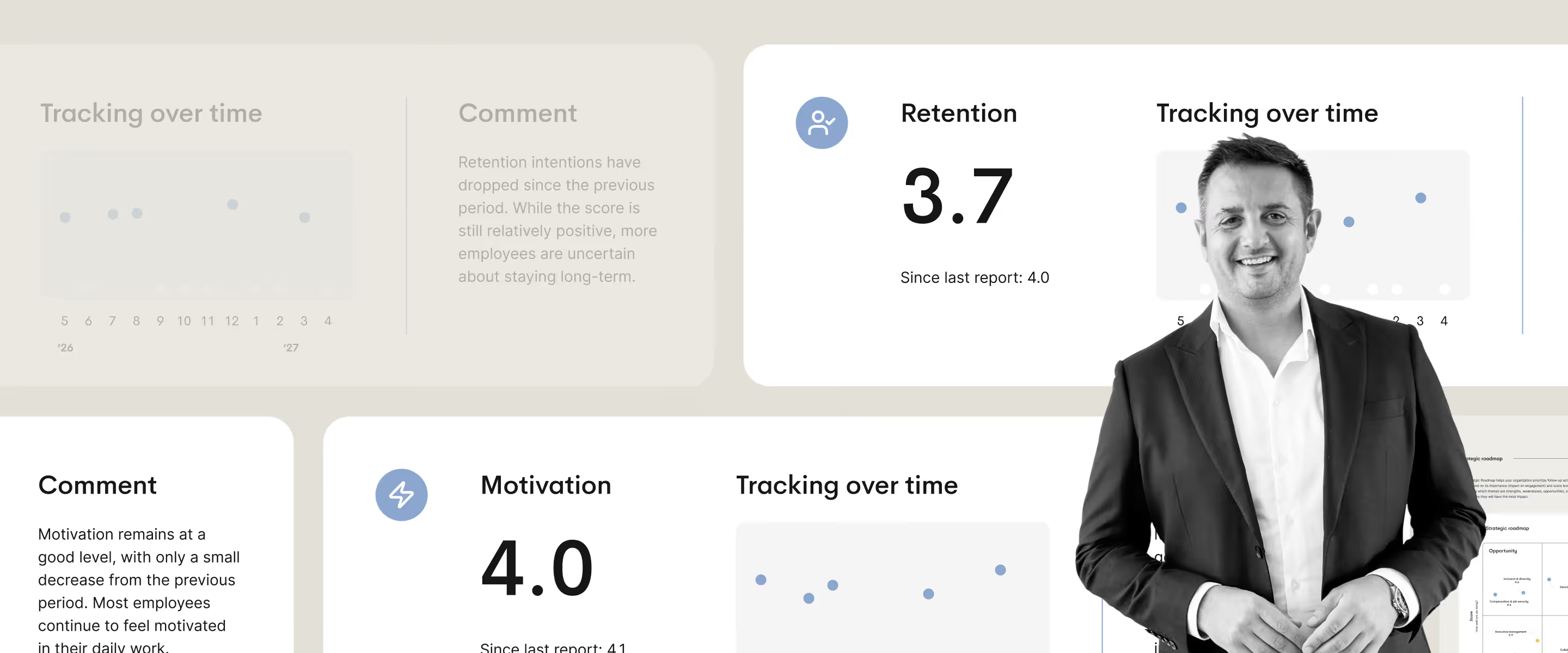

In the article 5 Good Reasons to Choose Enalyzer for Your Next Employee Survey, I introduced Employee Insight Reports. In this article, I take it a step further and explain the difference between classic dashboards and Employee Insight Reports — and why that difference is decisive if employee surveys are to translate into prioritization, action, and strategic HR.
Many organizations measure employee wellbeing. Few translate those measurements into real decision power.
I often meet HR directors and executives who say:
“We have a great dashboard. But we lack clarity on what we should actually do.”
It is not data that is missing. It is prioritization.
That is why we at Enalyzer have developed the Employee Insight Report, which I will explain in this article.
Dashboards show scores, trends, and segments. They create overview. But they rarely answer the questions that matter in the executive room:
This is where the difference between a dashboard and a Employee Insight Report becomes decisive. And why many companies consider Enalyzer among the best Employee Engagement Survey Providers in the market.
Dashboards are important. They create transparency and accessibility. Leaders can see development over time, compare teams, and identify deviations.
But a dashboard is, by nature, descriptive. It shows what is happening. Not why it is happening. And not what should be prioritized.
In practice, I see three classic pitfalls.
First, organizations focus on the lowest scores. It seems logical. But a low score is not the same as high impact. If a theme has limited influence on engagement and retention, improving it will have minimal strategic effect.
Second, the organization drowns in segmentation. You can drill down into age, tenure, departments, and functions. But without an analytical structure, it quickly becomes interesting without being actionable.
Third, the link to the business is missing. Wellbeing is presented separately from economics, productivity, and churn risk. As a result, the employee survey becomes an HR project rather than a strategic management tool.
Dashboards visualize data. They do not prioritize. And without prioritization, the classic gap between data and action emerges.
At Enalyzer, we do not work with isolated surveys, but with an integrated monitoring system where main surveys, pulse surveys, and thematic surveys interact within one structured framework.
However, the central deliverable is not the dashboard. It is the EmployeeInsight Report.
A Employee Insight Report is an analytical and strategic summary that translates data into decision points. Where the dashboard answers “What is the score?”, the Insight Report answers:
The key methodological approach is driver analysis.
Instead of focusing on what scores lowest, we analyze which factors statistically have the greatest impact on organizational health, engagement, and retention. This enables us to identify the few areas where improvement will truly move the whole organization.
A theme may have a moderate score but be the second-strongest driver of engagement. Another may have a low score but minimal effect on overall health.
That difference is decisive for ROI.
A Employee Insight Report typically includes:
This changes the leadership dialogue. The conversation shifts from averages to impact — and from opinions to evidence.
AI is used to summarize complex data patterns and structure recommendations. But it operates on top of a validated measurement model and regression-based analyses. AI amplifies insight. It does not replace professional expertise.
The biggest risk in employee surveys is not low scores. It is lack of follow-up.
When employees repeatedly respond to surveys without experiencing visible improvements, both response rates and trust decline. This creates a “say-do gap” that undermines future initiatives.
The Employee Insight Report is designed to reduce this gap.
First, it creates clear prioritization. Leaders do not receive 12 focus areas, but 2–3 strategic initiatives with documented impact.
Second, it clarifies the level of responsibility. Some challenges can be solved within individual teams. Others require structural decisions regarding resources, processes, or leadership frameworks.
When that distinction is unclear, frustration emerges. Managers become responsible for issues they cannot change. Or the organization underestimates structural risks.
The Insight Report deliberately distinguishes between:
Third, it connects wellbeing to economics. Increased churn risk, loss of key competencies, and reduced execution capacity are not abstract HR topics. They are business exposures.
When leadership can see the financial consequences of increased churn or declining engagement, prioritization changes significantly. Wellbeing is no longer a soft topic. It becomes a risk management discipline.
The impact rarely appears dramatic overnight. But over time, we typically see stabilization of churn, reduced organizational friction, clearer prioritization, and increased execution capacity.
This is where the value is realized.
Enalyzer does not just deliver surveys and dashboards.
As a leading provider of employee engagement and wellbeing measurement solutions, we transform employee data into strategic decision support through Employee Insight Reports.
We help you identify the most important drivers, visualize risks, and prioritize the initiatives that genuinely improve wellbeing, retention, and performance.
We'll match you with the right expert.