Many employee surveys are conducted with good intentions but fail to deliver real value. This article explains the most common mistakes organizations make when designing, interpreting, and following up on employee surveys, and how a data-driven approach can turn surveys into a powerful leadership tool.


Most organizations conduct employee surveys with the best intentions. Yet many surveys end up creating frustration, noise, and in some cases even mistrust rather than clarity and action.
The problem is rarely that organizations measure. The crucial issue is how they measure, what they choose to measure, and especially what they do afterward. When employee surveys fail to create value, it is almost always due to the same recurring mistakes. Mistakes that undermine data quality, weaken leadership credibility, and reduce employees’ motivation to participate in the next survey.
One of the most classic mistakes already appears during the design phase. The questionnaire grows because every topic feels important. Employee wellbeing, leadership, collaboration, IT, the cafeteria, parking, and the physical work environment all find their way into the survey.
The result is often a long questionnaire covering many themes and even more slides in the final report.
The problem is that when everything is important, nothing is prioritized. Leadership is left without a clear answer to the central question: what should we do first if we want to create real change?
Data-driven employee surveys are not about measuring everything. They are about identifying the few factors that have the greatest impact on wellbeing, engagement, and ultimately performance.
I have previously written an article about an evidence-based approach to measuring employee wellbeing, which I recommend exploring further.
Many surveys stop at describing the situation. Employee satisfaction has declined, the leadership score is low, or work pressure has increased.
But without explaining why.
Without analyzing relationships and drivers, organizations risk treating symptoms, focusing on the wrong initiatives, and investing resources where the impact is minimal. Data-driven leadership requires understanding what influences what. Otherwise, follow-up actions become guesswork rather than decisions.
Another common mistake occurs during the interpretation of results. Small year-to-year fluctuations are often treated as major problems, while differences between departments are interpreted as signs of poor leadership or insufficient effort.
Without an understanding of statistical uncertainty, sample sizes, and natural variation between teams, even minimal changes can be overinterpreted.
This creates unnecessary concern, misplaced focus, and in the worst case mistrust toward the entire survey. Data-driven employee surveys require respect for data — not just fascination with numbers.
When comparing data, it is essential to account for:
Without this context, small changes can easily be misinterpreted as significant issues.
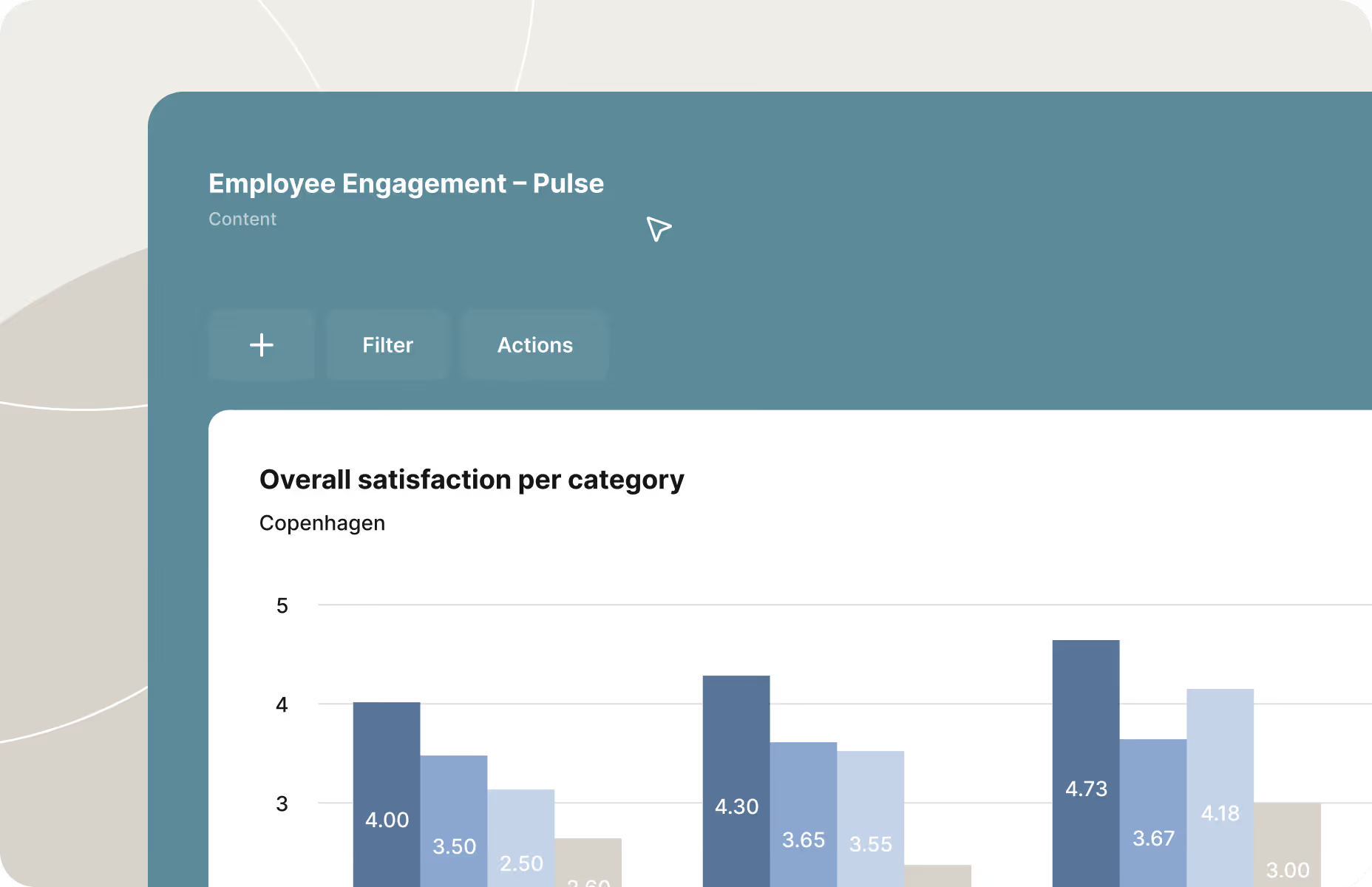
Perhaps the most damaging mistake is the lack of follow-up. When employees repeatedly take the time to share their experiences but do not see visible changes, both engagement and response rates decline significantly.
Research shows that lack of follow-up is not just ineffective — it can have a directly negative impact on engagement because employees feel their voice does not matter.
I am firmly convinced that measuring without acting is in practice worse than not measuring at all.
In many organizations, results are widely distributed and managers are expected to figure out what the numbers mean on their own.
This often leads to large differences in interpretation and follow-up. Some managers dive deep into the data, while others focus mainly on the numbers that support their existing narrative. I have seen this repeatedly in my work across many organizations.
Without a shared language and common understanding, the employee survey risks becoming a mirror where everyone sees what they already believe instead of serving as a shared basis for decision-making.
Even the best survey platform does not create insight by itself.
It is naive to assume that without methodological questionnaire design, analytical understanding, and experience with organizational context, meaningful conclusions can be drawn from the survey.
Organizations risk ending up with impressive dashboards but unclear decisions. The difference between having data and using data correctly is critical.
Finally, employee surveys lose their strategic importance when they are perceived as something HR “runs”, something separate from daily operations, or something that happens once a year.
Organizations that succeed use employee surveys as a leadership tool closely linked to priorities, decisions, and systematic follow-up.
Robust employee surveys are characterized by:
Enalyzer works specifically to help organizations avoid these pitfalls. This can be done through professional employee surveys where our consultants handle methodology, analysis, and insights, or through software that enables organizations to work data-driven on their own.
The biggest impact occurs when data-driven methods are combined with practical experience, particularly in complex organizations where wellbeing, workload, and leadership interact closely.
Most mistakes in employee surveys are not technical. They are leadership issues.
They stem from a lack of prioritization, a lack of courage to focus, and a lack of willingness to act on what the data actually shows.
When used correctly, employee surveys are one of the most powerful tools modern organizations have. When used incorrectly, they become noise — or worse: a promise that is never fulfilled.
An evidence-based approach to employee surveys and measuring employee wellbeing.
We'll match you with the right expert.